SHOP BY ARTISTS SUBJECTS STYLES NEW ARRIVALS BEST SELLERS spacer
Art as a Way to Shape the Future

Posted on Friday May 15, 2009

The sculpture you are looking drew ridicule and shame when the artist first exhibited it in 1913… nearly a century later, symphony number one is considered a pivotal example of abstract sculpture…

Your immediate reaction might be to dismiss this work, just as your boss would dismiss you after what anyone would agree was an honest mistake.

But if you allow yourself to really look at this piece you will see that it awakens all senses simultaneously…

The artist who was so experimental and ahead of his time, had a lingering hope that someone, someday would feel what he felt, and see what he saw.

This video is true of all great artists, who attempt to sculpt not just with clay or paint on canvas, but more than anything, help us shape the minds and thoughts of the future…

Post by Amitai Sasson
Category: Art Reflections and Changing trends
Modern Art Movements Explored…

Posted on Monday April 13, 2009

When choosing art for your home, it is important to understand the piece’s background and history. Art is an extension of its maker, so cleanly categorizing art is like trying to categorize human personalities. It is an impossible task that needlessly detracts from each individual’s special characteristics. However, when shopping for that perfect piece of art for your home or office, narrowing down the huge array of options by the features you typically appreciate makes the process easier and more enjoyable. The following list contains some of the more popular art movements from the last few centuries and features of their paintings. Be aware that there have been many art movements, and the lines between each shift are blurry, so this list is far from comprehensive. For more information, visit your local library or book store for a great book on art history.

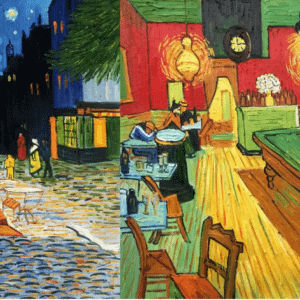
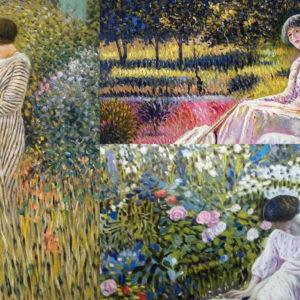
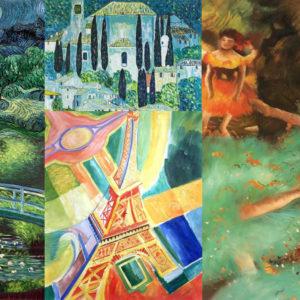
Impressionism – Beginning in France in 1867 and continuing through 1886, this movement marked a distinct departure from traditional European art. Relying on the physics of color and groundbreaking techniques, artists used smaller, concentrated touches of pure color, called pointillism, to capture the artist’s impression of that image. As the painting comes together, the color merges to form unique shades that catch the light in specific ways. It is supposed to look like the image in the artist’s mind, were a person to catch a fleeting glimpse of it. In an impressionist painting, color is much more important than detail. Post-impressionism came soon after to represent an extension of Impressionism while rejecting the limitations of the former movement. Vincent Van Gogh exaggerated pointillist techniques to include contrasting brushstrokes and points of pure color.
Artists Include: Claude Monet, Edouard Manet, Edgar Degas, Pierre-Auguste Renoir, Camille Pissaro, Vincent Van Gogh, Paul Cezanne

Symbolism – Also known as Synthetism, this movement lasted roughly from 1885 to 1910. Symbolist artists were fascinated with themes of the mystical and the visionary, and interested in the darker corners of the soul. For instance, they focused on concepts like death, debauchery, and the erotic. Unlike other movements during this period, symbolists focused on feeling and emotion rather than the intellectual perception of real images. They believed emotion was expressed in every aspect of a work of art, down to a single dot or line.
Artists Include: Gustav Klimt, Edvard Munch, Paul Gauguin

Expressionism – As a movement stemming from literature, Expressionism suffused fine arts areas outside of the visual arts, including cinema, theater, and dance. From 1905 to 1925, Expressionists distorted and exaggerated images for emotional effect. Rather than imitate reality, the artist expresses his reaction to reality and shows his perception using vibrant colors, agitated brush strokes, and disjointed spaces. The goal was focused on expression over form.
Artists Include: Wassily Kandinsky, Marc Chagall, Egon Schiele

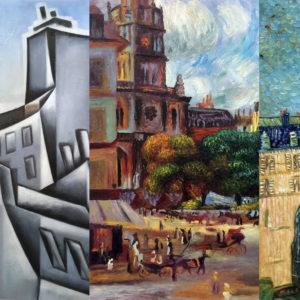
Cubism – Originating in Paris, Cubism began in 1907 and lasted through 1914. Conceptualized as a “new way of representing the world,” Cubists rejected conventional modes of art and instead took images and distorted them to show one image from several simultaneous points of view. The goal was to display images as the mind sees them, not the eye.
Artists Include: Pablo Picasso, Georges Braque, Marcel DuChamp

Dadaism – Another pervasive form of art, Dadaism began as a literary movement between 1915 and 1922. Fueled by the spirit of revolt after World War I devastated Europe, artists from all genres focused on the unpredictable and fleeting nature of expression and creation. Poet Tristan Tzara named the movement by stabbing a penknife through pages in a dictionary to randomly find a name, and one of Max Ernst’s most famous exhibits provided axes to visitors with which they were to smash the art. Relying heavily on the importance of chance in creation, Dadaism aims to be unpredictable, violent, whimsical, and altogether nonsensical (after all, the inner workings of the mind encompass those characteristics).
Artists Include: Max Ernst, Andre Breton

Surrealism – Related to the Cubist and Dadaist movements, Surrealism was shaped by the unpredictable process of creation and perception. From the 1920s to the 1930s, Surrealist paintings focused on perceptions from a dream-like state (most likely influenced by emerging Freudian theories of the time). With time to heal between the two wars, the spirit of the movement was much lighter than the angst-ridden Dadaist period. The aim was to merge the subconscious aspects of the dream world with conscious reality to create a “super reality.”
Artists Include: Georgia O’Keeffe, Rene Magritte, Joan Miro, Salvador Dalí

Again, this list is far from comprehensive. Art movements are fascinating and intricate, and it is hard to understand the stylistic properties without seeing examples from the movement. If you’re interested in what you read here, I strongly encourage you to learn more about the art world through art history books and (especially) museums. It will make art acquisition much more enjoyable and enable you to choose the perfect images.

Post by Amitai Sasson
Category: Hot news from the art community
Klimt The Kiss – The Story behind the Passion

Posted on Thursday March 26, 2009

This is the first of a series of videos depicting The Private Life of a Masterpiece…

This episode talks about Gustav Klimt and his most famous painting, The Kiss.
If the success of a work of art could be judged by the number of times it is reproduced, then the kiss is arguably the most successful painting in all of western art. The trouble is, the “Kitch” threatens to obliterate the Kiss…

The Kiss is a very sexual painting, it is the peak of an erotic love affair as the moment the lips touch is a moment that is to be cherished forever. We will sacrifice everything for that powerful moment…

But this enigmatic image has a strange story to tell…

I find this video fascinating and I love how it gives so much information about the Masterpiece. It is as if the painting takes life and fills you up with emotions and desires; almost human qualities to an artist creation.

In my opinion, this is the best art related documentary series I have ever encountered. Each episode is about a different masterpiece and they give so much life and volume into each work of art it makes the painting jump at you when you see it in person.

Post by Amitai Sasson
Category: Hot news from the art community
Art History Timeline

Posted on Tuesday February 24, 2009

The following is an amazing art history timeline:

It’s always good to get a wide perspective on the art world. When looking at this timeline you get a sense of how art has its own pulse and evolves in a furious pace towards the unknown future.

What will be considered artistic in 50 years? Will the greats of today still be considered greatin the future?

How will the art scene evolve can be determined by looking back at art history and see how we took a giant leap to where we are today.

Post by Amitai Sasson
Category: Hot news from the art community
Art Museums to See before You Die

Posted on Thursday February 12, 2009

Museum of Modern ArtBotticelli, Da Vinci, Van Gogh, Monet, Picasso, Rembrandt, etc. – these names are some of the most celebrated masters of the art world. With the improvements in technology, their masterpieces are widely available for view online, in books, on post cards, etcetera, but this cannot be used to replace the real thing. Seeing prints of these incredible works of art is the equivalent to seeing a movie instead of reading a book; you get an idea of what it’s about, but you cannot possibly capture the magical essence of the story or its characters. When you see a painting in person, the brush strokes tell a story about the artist who created them and his state of mind while he painted. The image is a visual manifestation of the artist’s secrets and thoughts that cannot be taken for granted or replaced. Although it is impossible to list all the best museums in the world, here is a basic list of museums you must see before you die. They house the greatest and most popular masterpieces that cannot be replicated.

  1. Metropolitan Museum of Art – New York City, New York. Located right in the continental United States, this is probably the easiest museum to begin your journey. This is one of the world’s largest museums with over 2 million pieces of artwork. Don’t expect to finish this in one day, but you can ease the load by purchasing a book or guide and deciding which pieces you want to see the most. The building itself is a work of art and guaranteed to inspire.
  2. MoMA (Museum of Modern Art)—New York City, New York. While in New York City, you must stop by this incredible collection of famous modern art. Dedicated to being the foremost museum for contemporary and modern art in the world, the MoMA houses works by Van Gogh and Monet, but also boasts considerable Matisse, Picasso, Magritte, and Dali collections. Visit this museum if you truly want to see the inside of an artist’s mind.
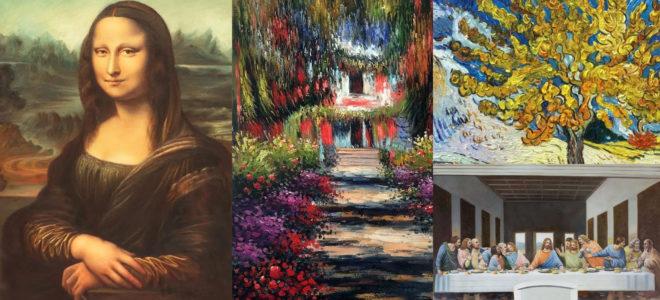
  3. Musee du Louvre – Paris, France. The world’s most famous museum, the Louvre alone is reason enough to visit Paris. Again, do not expect one or even two days to suffice. Housed in the old Louis Monarchy palace that features the glass pyramids, the Jardin des Tuileries, and halls and halls of incredible artwork. Divided into halls by time period, if you’re limited with time you can choose which eras you appreciate the most, but the best thing to do is buy a book or look online and decide which pieces you want to see the most. With works of art like the Venus de Milo, the Mona Lisa, and countless Greek, Egyptian, and Renaissance works, everyone will find something they want. If the price tag of admission is a little too hefty, try going on a Thursday evening. It’s crowded, but admission is free.
  4. Musee d’Orsay – Paris, France. Housed in an old train station with a breathtaking glass roof, the art simply belongs here. This collection of 19th and 20th century art houses incredible paintings by Monet, Van Gogh, Lautrec, Monet, Manet, Renoir, Degas, and countless others. Van Gogh’s “Starry Night,” the famous Whistler, and Degas’s ballerinas do not even begin to break the surface on the famous paintings you’ll find here. It’s also a little less crowded than the Louvre, so you can get closer to the paintings.
  5. Uffizi Gallery – Florence, Italy. Originally constructed to display the Medici art collection and now housing some of the world’s most famous Renaissance paintings, the Uffizi Gallery features works by da Vinci, Michelangelo, Botticelli. See “David” and “The Birth of Venus” among thousands of other’s in one of the world’s oldest galleries.

This very basic list outlines some of the most influential art galleries in the world. Despite your personal art preferences, every person should visit every one of these before they die. Once you fall in love with the works hanging on the walls, bring them into your home. Now that you have seen them in person, you can surround yourself with art replicas to remind you of the originals (think watching the movie because you don’t have enough time to read the book in one setting). There are plenty of sites online that sell oil painting reproductions. Try to find one with paintings hand painted by actual artists for the best results. Either pick a room in your home or decorate the entire home with these lovely paintings. Like a blank canvas, remember that the less you have going on in a room, the more beautiful these paintings will look when they add a pop of color. Add art lighting on the ceiling to bring dramatic attention to the paintings and you will be reminded of your wonderful travels every time you see them.

Post by Amitai Sasson
Category: Art Travel Guide
Top 10 Best Artist Films Ever Made

Posted on Wednesday February 4, 2009

The ties between great artists and motion picture have always been a personal intrigue of mine. It seems the film tends to transcend the artist and his masterpieces from their two-dimensional canvas confines into the conscious popularity of the general public.

I wanted to take this opportunity and go through my personal top 10 list of famous artists depicted in motion picture, and see how this exposure has changed the perspective of the public on their art.

  1. Girl with a Pearl Earring (2004) – This beautiful movie give us a glimpse into the world of Johannes Vermeer in Holland, 1665. The climatic cinematographic treatment left me in awe. You wouldn’t think a movie could take form of a Vermeer painting, but Girl with a Pearl Earring is filmed with an amazing range of luminous glows that evoke the Dutch artist’s masterworks. Of course, it helps that much of the movie centers on Scarlett Johansson whose creamy skin and full lips have a luminosity of their own. Johansson plays Griet, a maid in the household of Johannes Vermeer, who finds herself in a web of jealousy, artistic inspiration, and social machinations. Though the pace is slow, Girl with a Pearl Earring genuinely conveys some sense of an artist’s process, as well as offering many chaste yet sensual moments.
  2. Rembrandt (1936) – This 1936 flick features Charles Laughton who brilliantly captures the inner turmoil of the passionate 17th-century genius of Rembrandt. In Amsterdam of 1642, master painter Rembrandt Van Rijn (Charles Laughton) enjoys a rich, full life in a beautiful, blinding, swirling mist of fame and fortune. But with the sudden death of his beloved wife and muse, his work takes a dark, sardonic turn that quickly offends even his most loyal patrons.
  3. Modigliani (2004) – Andy Garcia stars as the painter Amedeo Modigliani, an Italian Jew, has fallen in love with a beautiful Catholic girl in post World War I Italy and Paris. The story of the movie is almost completely untrue… but there are some particular anecdotes that bring light into the life of this talented painter and sculpture.
  4. Pollock (2000) – Ed Harris directs and stars in a film that depicts his fascination with Jackson Pollock which only equals his physical similarity to the artist. Harris’s devotion assured a work of integrity, honoring the artist’s achievement in abstract expressionism, but at the same time acknowledging that Pollock was a tormented, manic-depressive alcoholic whose death at 44 (in a possibly suicidal car crash) also claimed the life of an innocent woman. The movie has elevated Pollock’s drip art to an American Icon and has sparked a huge lift in prices for Pollock’s masterpieces. Pollock currently holds the record of the most expensive painting ever sold at over $150 million!
  5. Frida (2002) – I debated if I should feature the original 1988 Mexican film or the recent Hollywood remake, I choose the latter because that’s the one I’ve seen, but I heard wonderful reviews for the original so I might have to check it out. Salma Hayek plays the Mexican surrealist painter Frida Kahlo, whose tempestuous life with her unfaithful husband, muralist Diego Rivera, drives the story of Frida. The script spends a long time talking about the greatness of Frida’s paintings, which has transcended her popularity in the art world immensely.
  6. Goya’s Ghosts (2008) – Starring my favorite actress of all time, Natalie Portman, Goya’s Ghosts is a sweeping historical epic, told through the eyes of celebrated Spanish painter Francisco Goya. Set against the backdrop of political turmoil at the end of the Spanish Inquisition and start of the invasion of Spain by Napoleon’s army, the film captures the essence and beauty of Goya’s paintings which is best known for both the colorful depictions of the royal court and its people, and his grim depictions of the brutality of war and life in 18th century Spain.
  7. Surviving Picasso (1996) – Anthony Hopkins stars in this epic which tells the story of Pablo Picasso and his passionate affairs with his many mistresses or muse as he calls them. The story begins in 1943 during the German occupation of Paris. Picasso is in his 60s, and as wild and passionate as a youth. While swearing eternal love to Francoise, his new muse, his path is littered with former mistresses who he pays regular visits to. From the sensual, phlegmatic Marie-Therese, the brilliant Dora, also a painter, whose feelings for him have brought her to a nervous breakdown, to his Russian wife, Olga, a former dancer, whom he has driven to the point of actual madness.
  8. The Impressionists (2006) – Looking back on his life in 1920, Claude Monet recalls the story of the Impressionists – a movement that shook the foundation of the art world. With his fellow painters, Auguste Renoir and Frederic Bazille, they begin a forty year struggle against the Salon, the annual state art exhibition. Monet along with his friends and rivals ultimately find the success that they only dreamed was possible.
  9. Lust for Life (1956) – Appropriately titled, for mere passion seems inadequate when describing this superb fictionalized biography of Vincent Van Gogh. Kirk Douglas is the tormented Dutch painter, whose life is chronicled from his ill-fated stint as a preacher to Belgian miners in 1878, to his Impressionist-inspired artistic awakening and psychological descent to suicide in 1890.
  10. Klimt (2006) – John Malkovich inhabits the role of dissolute artist Gustav Klimt so completely one almost expects to see his wild-eyed features reflected in Klimt’s well-known painting The Kiss. The story is a (very) loose biopic about the tortured life of the Austrian artist, whose deathbed ruminations begin the film and the flashbacks that begin to paint the portrait of his incredible, hedonistic life.

There were many more films done on great artists, these are just my personal favorites. I think some of these movies do a great job portraying what goes on in the artists head as he completes his masterpiece. The synergy between oil paintings and the movies is not an easy task by any measure, but as seen in the aforementioned list of movies, when you have the right combination of a good story and fantastic acting you can achieve great things by merging these two disciplines together.

Post by Amitai Sasson
Category: Art in Movies
Rene Magritte – Apples, Pipes and Bowler Hats

Posted on Thursday January 29, 2009

Rene Magritte - The Son of Man oil paintingJust over 100 years ago, Rene Magritte was born in Belgium. By 1922 at the age of 28, he sold his first painting. Even though the Magritte family were personally acquainted with Salvidor Dali and his family in Spain; it would be another four years until Rene begins to experiment with surrealism.

He contributes to the final issue of “Révolution Surréaliste” by painting the first version of his famous work “The treachery of Images”. One of his most famous is a painting of a pipe which in fact, looks like an advertisement. Below are the words “Ceci n’est pas une pipe” (This is not a pipe).

By 1943, just as WW2 was coming to a close, Magritte began exploring his “Renoir” or “Solar” style which he continues until 1947. This is the style we have come to know Magritte by. In all of Magritte’s paintings, he forces the viewer to really look at what he is seeing. He takes everyday objects and turns the ordinary into the exra-ordinary.

The image of a man in a bowler hat is one of his most recognizable and represents the common man. The first version, “The Son of Man” was actually a self portrait, painted in 1964. It has remained a remarkably iconic image even to this day. When Rene was asked about the man’s obscured face, he commented that “There is an interest in that which is hidden and which the visible does not show us. This interest can take the form of a quite intense feeling, a sort of conflict, one might say, between the visible that is hidden and the visible that is present”.

Another of his images is the giant green apple, called “The Listening Room”, 1952. In this painting, we see a massive green apple out of context in a room with a glass window, wood flooring and white trim. In 1958, a second version was painted with near identical apples but in a room with gray brick flooring and an open-arched window. Juxtaposing size and context was one of Rene’s recurring ideas and is what makes his paintings so intellectually engaging.

Post by Amitai Sasson
Category: About various artists
Farewell to Andrew Wyeth

Posted on Monday January 19, 2009

Andrew Wyeth's painting Christina's World
Artist Andrew Wyeth, most famous for his work, Christina’s World, past away last week at the age of 91. His art portrayed the hidden sorrow of the men and women of Pennsylvania’s Landscape.

Christina’s World shows a crippled woman looking in anguish over her farm house. The painting seems so real, it looks like a photo. Such an amazing talent, Wyeth’s works are portrayed in the MoMA, and incorporated into the popular Blue Man Group act (you have to check it out…). Wyeth even made the famous Snoopy comics: “After a fire in his dog house destroys his Van Gogh, Snoopy replaces it with an Andrew Wyeth…”

My favorite quote of Wyeth is, “Really, I think one’s art goes only as far and as deep as your love goes,” taken from a Life magazine interview in 1965. I think that sums up very well, the passion and obsession of Wyeth with the bare canvas.

Post by Amitai Sasson
Category: Hot news from the art community
Cezanne and L’Estaque Paintings

Posted on Wednesday December 31, 2008

cezanne and l'estaqueCézanne seems to have first visited the fishing village of L’Estaque in the mid-1860s. During the Franco-Prussian War (1870–71), he sought refuge in this picturesque, sheltered port, lodged between the mountains and the sea near Marseilles. Upon his return there in the summer of 1876, he enthused to Pissarro: “It is like a playing card. Red roofs over the blue sea. . . . The sun is so terrific here that it seems to me as if the objects were silhouetted not only in black and white, but in blue, red, brown, and violet.” Cézanne painted some twenty canvases of L’Estaque over the next decade, a dozen of them facing toward or across the gulf of Marseilles. In the distance of this painting, atop the hill to the right of the jetty, the towers of Notre-Dame-de-la-Garde stand watch over the city of Marseilles.

Post by Amitai Sasson
Category: About various artists
Difference between an oil painting and a print

Posted on Sunday December 21, 2008

This video is a great representation of the difference between an oil painting and a print…

Here is a link to the oil painting they are talking about: Claude Monet – Poppy Field in Argenteuil See if you can tell the difference between an oil painting and a print…

Post by Amitai Sasson
Category: Expert Advise and Interior Design tips