So da Vinci Has a New Painting: Savior of the World
A painting by Leonardo da Vinci thought lost was actually safe and sound in a private collection
Written by Tiffany Chaney on November 11, 2011
The painting was rumored to be in existence from a mere etching by Hollar in 1650, and the piece called “Salvator Munti (Savior of the World)” had passed from hand to hand privately for five centuries until it was recently loaned to the National Gallery and publicized this past July. Where was this painting for five centuries?
Let us open the art history time capsule. It’s almost as potent as Ibprofren; however, its use is slightly different. Under recently applied varnish, specialists date the lost masterpiece from either 1498-1499 (in Milan) or 1500-1506 (in Florence). In the 17th century the painting passed from the hands of Charles I to the Duke of Buckingham 1688 until it was sold by his descendants in 1763 as a da Vinci masterpiece only to resurface in 1900. It appears in the 1913 Cook catalog, where Sir Herbert Cook attributes it to “contemporary painter of Leonardo’s School.” Specialists, however, have little doubt that it is the lost da Vinci masterpiece. After removing layers of discolored varnish and evidence of crude retouching, the style in which the work is rendered is nearly evidence enough for scholars.
Reportedly, the work turned up in a private American collection and is now owned by a party named R.W. Chandler. This November, the general public will have the privileged opportunity to view the long lost work in person. The National Gallery, as a part of this historical exhibition, also managed a record eight museum loans of priceless da Vinci works that usually don’t leave the museum wall. These works include “Leonardo’s “Portrait of Cecilia Gallerani (The Lady with an Ermine)”, about 1489-90, on loan from the Czartoryski Foundation and the National Museum in Cracow, “Five character studies (A man tricked by gypsies)”, about 1493, from The Royal Collection and “Virgin and Child (The Madonna Litta)”, about 1491-5, from The State Hermitage Museum, St Petersburg,” according to The Art Newspaper.
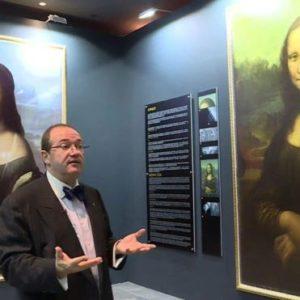
Most fascinating about the “Savior of the World” painting, is da Vinci’s emphasis of power in hand gesture. This is second only to the Mona Lisa’s secret smile. Perhaps we can suppose she knew where it was hidden all along.


When Pissarro began painting cities and factories, he wasn’t a one-sided anarchist but more of an optimist. To look at one of these artworks, it is clear that though smog taints blue skies there is an allure and thrill attached to the urban fast life, a new and sometimes uncanny sort of beauty. Pissarro painted this allure. It’s present in many of his cityscapes. Some theorize that he hated and loved the urban sprawl. A melting pot of mixed feelings, the proof is the accuracy of the artwork. Nothing is embellished. It would stand to reason that Pissarro would feel similarly about the aspects of information technology that while they consume our lives like smog, empower the individual voice within the masses.
Art historians at the museum say that if this is true then the “self-portrait” will be the only known portrait created by