
David Sasson on Practical eCommerce

Written by Amitai Sasson on August 5, 2010

You could argue that a center of the online, retail art world is in Kansas. That’s where overstockArt.com is located, and in nine years it has grown to be a leading, online retailer of original art reproductions. The founder and CEO, David Sasson, has grown the business from inception to where it is today, and he joins Practical eCommerce’s Kerry Murdock to discuss it all.

Listen to the full podcast: 

Revolutionizing the Wall Décor Industry

Written by Amitai Sasson on May 11, 2010

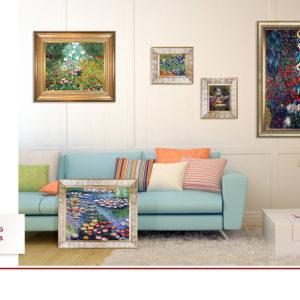
overstockArt.com launches view in room applicationoverstockArt.com is making purchasing art online a personalized and interactive experience with the launch of the “View in a Room” application.

The new tool will revolutionize the way people buy wall décor online. “View in a Room” allows customers to upload an image of a wall in their home and then place oil paintings that are available through the online retailer onto their walls. This new visualization tool essentially allows users to gauge how a painting will look on their wall before purchasing it and taking it home – something they cannot do in their local gallery.

“As an online retailer it is important to make shopping on our site a personal experience for our customers,” said David Sasson, CEO of overstockArt.com. “‘View in a Room’ makes shopping for art online a personal, interactive experience, as people can now virtually experience the art in their home before purchasing it.”

Although retail is a mature online category, shopping for wall décor online is not. As such, overstockArt.com has invested heavily in creating a unique experience shopping for art online. “This is what makes it exciting for us to offer tools that will revolutionize the buying process for an entire industry,” said Sasson. “This new tool is bridging the gap between the touch and feel experience of shopping at a brick and mortar store compared to the obvious advantages of shopping online.”

overstockArt.com feels confident its customers will embrace “View in a Room.” “We are expecting to increase our conversion rate by 30 percent with this new tool because it’s going to make shopping for art online that much easier,” said Sasson.

“View in a Room” has two final enhancements scheduled before it is completely rolled out. In early June users will be able to test out framing inside the system and by late June customers can share an image of the painting on their wall with their friends and family via e-mail or their social networks. The final enhancement will make purchasing art online a social experience as people will enlist their social networks to help them select which oil painting will look best hanging on their wall.

“Most things on the Web aren’t social quite yet, but that is changing and we are working to establish ourselves as an online retail leader by making shopping online not only a personal and interactive experience, but a social experience as well with this new tool,” stated Sasson.

Picasso Breaks the Auction House Record

Written by Amitai Sasson on May 6, 2010

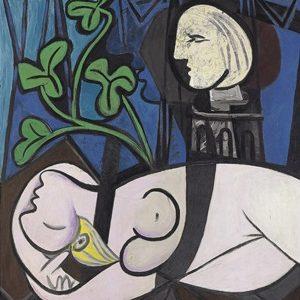
PicassoNude, Green Leaves and Bust oil paintingOn Tuesday night, Pablo Picasso was restored to what many consider his rightful place at the top of the most important artists in the world. A canvas that he painted in a single day in March 1932 was bought for $106.5 million (£70.3 million) at Christie’s in New York – making it the most expensive work of art ever sold at auction. The news must have turned dealers, auctioneers and art collectors delirious with delight as in the art world, at least, the good times appear to be back.

This is not the first time that Picasso has held this exalted record. In 2004, his Boy with a Pipe, which dates from 1905 at the height of his so-called Rose Period, sold at Sotheby’s in New York for a record-breaking $104.1 million. The extraordinary thing is that Picasso’s Nude, Green Leaves and Bust, which set the new record this week, looks nothing like Boy with a Pipe, in subject matter or style. Most people unfamiliar with modern art would surely assume that the two paintings had been made by different artists.

Nude, Green Leaves and Bust, which was last sold, for $19,800, to a family of American art collectors in 1951, is a very different proposition. It shows a naked woman lying asleep beneath a classical bust and a rampant philodendron plant – but it is not remotely realistic. The bold blocks of colors are flat and intense, bound by thick black outlines. The woman’s skin is an extraterrestrial lavender. Her arms are not anatomically correct, but instead curl beneath her head, mirroring the tendrils of the plant above her. A shadowy profile (a self-portrait?) floats among the folds of the blue cloth in the background, in between the plant and the bust. Overall, the painting has a distorted, dreamy, childlike aspect. Nearly three decades after Boy with a Pipe, Picasso was no longer interested in making paintings that even pretended to be life-like.

The story behind Nude, Green Leaves and Bust helps us to understand why it is considered such a wonderful work of art – and why Picasso, in the words of one of his dealers, illuminated the 20th century like a comet.

The woman is a portrait of Picasso’s muse and mistress Marie-Thérèse Walter, whom the artist met in the 1920s, when he was in his mid-40′s, and she was still a teenager. “When I met Picasso I was 17,” Marie-Thérèse said in an interview with Life magazine in 1968. “I was an innocent young gamine. I knew nothing – life, Picasso, nothing. I had gone shopping at the Galleries Lafayette, and Picasso saw me coming out of the metro. He simply grabbed me by the arm and said: ‘I’m Picasso! You and I are going to do great things together.’”

Picasso and Marie-Thérèse soon began an affair, which rejuvenated the middle-aged artist and quickly suffused his work. He embarked on a run of sumptuously erotic canvases which are the visual equivalent of great love poems. These dazzling paintings, of which Nude, Green Leaves and Bust is a fine example, are characterized by bright, joyful colors and plump, suggestive forms. Their brushwork is lush and fluid. Marie-Thérèse is frequently presented naked and asleep, as though resting after sex.

For better or worse, Picasso took a wrecking ball to six centuries of art history – and, by grappling with the great Western tradition, he fashioned a revolutionary new visual language better known as the modern art era.

Top 10 Oil Paintings of Motherhood

Written by Amitai Sasson on April 20, 2010

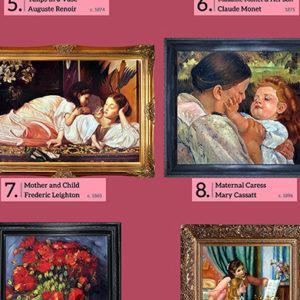
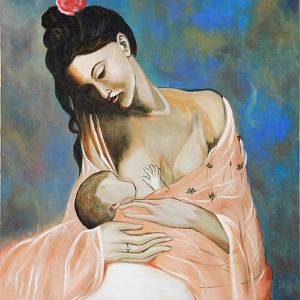
Pablo Picasso - Maternity oil paintingoverstockArt.com, the leader in handmade oil painting art reproductions, released today its Mother’s Day Top 10 list. This year’s list names the top 10 oil paintings featuring images of motherhood.

Topping the chart is Claude Monet’s masterpiece Poppy Field in Argenteuil. Oil paintings by master artists Mary Cassatt, Gustav Klimt, Vincent van Gogh, Pablo Picasso, and Pierre-Auguste Renoir also made the list.

“Many master artists depicted images of motherhood in their oil paintings,” said Stacy Sasson, co-founder of overstockArt.com. “No other art form better exemplifies the tender, timeless bond between a mother and a child.”

The oil paintings that made the 2010 Mother’s Day Top 10 list are:

  1. Poppy Field in Argenteuil, Claude Monet – In this colorful oil painting, originally created in 1873, Claude Monet painted his wife and son strolling together among the poppies.
  2. Le tre eta della donna (Mother and Child), Gustav Klimt – Mother and Child is part of Klimt’s famous oil painting Three Ages of Woman. The painting depicts an image of a mother cradling her young son. The original was created in 1905, three years after the death of Klimt’s baby son, Otto.
  3. Breakfast in Bed 1897, Mary Cassatt – The subject of mothers and children recurred in many of Cassatt’s works. In this piece, a child’s attention wanders as she is held in her mother’s loving embrace.
  4. First Steps, Vincent van Gogh – From late 1889 to 1890, while van Gogh was a voluntary patient at the asylum in Saint-Rémy, he painted twenty-one copies of Jean-François Millet’s works. In January 1890, van Gogh transferred a photograph of Millet’s First Steps to canvas.
  5. Maternity, Pablo Picasso – This stunning oil painting, originally created in 1905, depicts the intimate bond of mother and child.
  6. Madame Monet and her Son, Claude Monet – This masterpiece, originally painted in 1875, depicts Monet’s first wife Claude and their eldest son, Jean.
  7. Summertime, Mary Cassatt – Although never a mother herself, Cassatt principally painted children and scenes of motherhood. Summertime illustrates a mother and daughter enjoying a leisurely summer day boating. The original masterpiece was created in 1894.
  8. Woman with a Parasol and Small Child on a Sunlit Hillside, Pierre-Auguste Renoir – Originally painted in 1874, this masterpiece depicts a mother relaxing in the grass while her young child wanders off in behind her in the tall grass.
  9. Hope II, Gustav Klimt – Although images of women and children are frequent in the history of art, depictions of pregnancy are rare. In Hope II a woman lowers her head toward her swelling belly. The original masterpiece was created in 1907-08.
  10. Pieta, Vincent van Gogh – Originally created in 1889 while van Gogh was staying at the asylum in Saint-Rémy, Pieta is the agonizing depiction of Mary in sorrow over her dead son.

The Mother’s Day Top 10 List was composed by pulling overstockArt.com sales data from April 2009 to March 2010. “Mother’s Day is our third busiest selling period of the year,” said Sasson. “People love giving their moms the gift of art for Mother’s Day – it is a wonderful expression of love that will last a lifetime.”

A Big Summer Season for Picasso

Written by Amitai Sasson on April 8, 2010

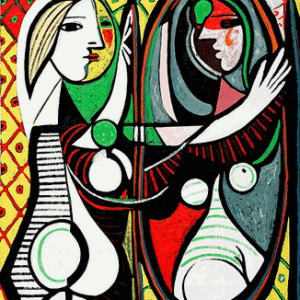
Picasso - Girl Before a MirrorIt’s a big season for Picasso in the northeast. MoMA has a show, the Philadelphia Museum of Art is doing a Picasso & Friends show. Later this spring the Metropolitan Museum of Art will exhibit 300 of its Picassos…

The Guggenheim is also taking part in the Picassopalooza by showing two great still-lifes as part of a seventh-floor collection portraying the importance of Picasso on the Modern Art World.

For some reason Picasso is back as the most popular artist of the past century. Picasso’s popularity is on the rise a trend that just does not seem to fade.

Gustav Klimt brought to life

Written by Amitai Sasson on March 24, 2010

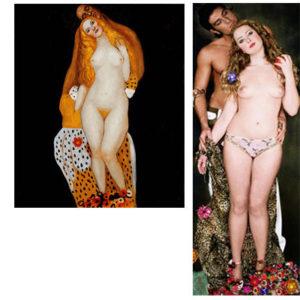
I ran across these recreations of Gustav Klimt‘s work on the Behance network and simply had to share them with you.

This collection of beautiful and artistic photos is called “La Esencia de Klimt” which translates to “Klimt’s Essence”.

As a long time admirer of the Austrian Art Nouveau painter, these fashionable, real-life recreations of his works captured my immediate attention. A group of talented folks have combined their photography, digital art, illustration, make-up, hair and styling (all found through Kattaca) to recreate some of Gustav’s most famous paintings.

I’ve added Klimt’s original paintings for contrast:
Adam and Eve - Gustav Klimt oil painting
Portrait of Adele Bloch-Bauer I - Gustav Klimt oil paintingDanae -  Gustav Klimt Oil PaintingThe Kiss (Fullview) -  Gusrav Klimt oil paintingThe Dancer - Gustav Klimt oil paintingThe Virgin - Gustav Klimt oil painting

Mark Rothko and his Mean Reds on Broadway

Written by Amitai Sasson on March 21, 2010

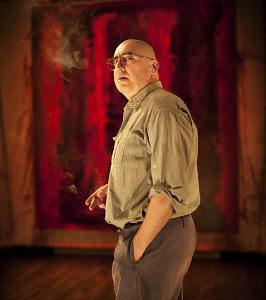
Mark Rothko paints with vigor on BroadwayA new production called Red is set to debut on Broadway on April 1st, the play is about none other than the Abstract Expressionist Painter – Mark Rothko.

Red was written by screenwriter John Logan, maker of Gladiator, The Aviator and the Sweeney Todd movie, among others. The play focuses mainly about the discussions regarding abstract expressionist aesthetics that Rothko had with his studio assistant while the famous painter was working on some of the most revolutionary canvases of his generation.

Red is set in 1958 as New York artist Mark Rothko (Alfred Molina) receives the art world’s largest commission to create a series of murals for The Four Seasons restaurant in the new Seagram building on Park Avenue. Under the watchful gaze of his young assistant, Ken and the threatening presence of a new generation of artists, Rothko faces his greatest challenge yet: to create a definitive work for an extraordinary setting. Red is a moving and compelling account of one of the greatest artists of the 20th century, whose struggle to accept his growing riches and praise became his ultimate undoing.

Rothko is played by Alfred Molina – a rare actor who conveys intelligence with visceral intensity. He makes you believe that what Rothko says, no matter how abstract it is, is of mortal importance to the painter. Molina has developed a specialty depicting 20th century artists as he already played another formidable painter, Diego Rivera, in the movie “Frida” along side Salma Hayek.

The actors in the play get their hands dirty throwing paint around on stage, the moment you step into the theater you are struck by the smell of oil paint in the air. The smell of the oil and the rage of the painter makes Red an extremely powerful theatrical experience.

So, if you are in New York in the following weeks, stop by the Golden Theater on 45th Street and enjoy a glimpse into the mysterious world of the 1950’s Abstract Expressionism.

“Women in Art” Twitter Sweepstakes

Written by Amitai Sasson on March 10, 2010

In honor of National Women’s History Month, the popular online gallery, overstockArt.com, is hosting the “Women in Art” Twitter® sweepstakes. The sweepstakes commences on International Women’s Day on Monday, March 8, 2010.

To participate in our FREE Oil Painting Giveaway. All you need to do is include the #overstockart tag in any tweet on twitter. Three winners will be selected at the end of the sweepstakes period. You can be creative with your tweet or re-tweet of our message, don't forget to follow @overstockart to find out if you've won.

Celebrate Women’s History Month and win a Hand Painted Oil Painting! http://tinyurl.com/ycqt7tr #overstockart

Tweet this!

You can tweet #overstockart as often as you like. Each of these tweets will be eligible and a winner will be chosen at random using an algorithm. No bots or automated scripts please, this is meant to be a bit of fun!

Three (3) winners can choose from any of our 20"x24" inch oil paintings featured in our Women's Gallery. After the oil painting is selected, we'll deliver it to your door!

Don't forget to follow @overstockart to find out if you've won.

Checkout our official sweepstakes page for the complete set of rules and to see if you are one of three lucky winners!

All Children Are Born Artists

Written by Amitai Sasson on March 3, 2010

The month of March is Youth Art Month – an annual observance to emphasize the value of art education for all children and to encourage support for quality school art programs. one might ask, what is so important about art that we need an annual event to observe it?

If we sit and observe whenever little kids draw, finger paint or play, it’s intriguing how they seem without self-doubt, judgment or fear of doing it wrong. A preconceived expectation of the end product doesn’t seem to play a role in what they are engaged in and in that moment they simply get lost in the doing of it. It’s as if they approach their art, free of inhibitions and with an openness to take risks, experiment and most importantly have fun. It’s as if being fully present in the moment and entering that space of spontaneity, comes so easily.

I recently spoke to someone who runs a local community art school. She shared with me that they had noticed a decreased attendance in their children’s art classes. When I asked why, she speculated that it was the result of kids being less and less encouraged to do art for the sake of the experience and for play. Instead, in order for parents to feel they were getting their money’s worth they were expecting their kids to produce a nice finished product at the end of each class. If the art piece resembled something out of preschool, their child must not be learning something valuable.

Is it possible that in this day and age of video games and computers, where shapes are colored within the clean lines of digital images, we’ve suppressed the urge to color outside of the margins? Are our children losing touch of their innate nature to create something in the mud, draw in the sand and venture down the road of their own imaginations? Is the art of trial and error no longer valued?

As we “grow up” the courage to create slowly moves into the background of our lives and we measure what we produce with labels of “Success” or “Fail” with nothing in between. We develop an apprehensiveness towards taking risks and the fear of doing it wrong keeps us from looking foolish in the process. Is learning to suppress free expression, suppressing our own imaginative instincts that we were naturally born with when we first entered this world?

“All children are born artists, the problem is to remain an artist as we grow up.” – Pablo Picasso

I once heard a grade school teacher encourage parents to, “Praise the effort rather then the outcome.” We often have the bad habit of discounting the process in it self. Undermining the steps in the middle that hold moments of exploration while focusing too much on the end product. If we approach our careers or our art giving value to the effort perhaps we will resurrect the courage to create; remembering what it was like to drenched our fingers in paint and draw out of the lines.

Sir Ken Robinson said it best, the ecology of our education will need to change and adapt. Art and creativity will need to take an active and central role for this world to develop and the only way we can do it is by seeing our children for the hope that they are.

A New Van Gogh Masterpiece Found

Written by Amitai Sasson on February 25, 2010

A New Vincent Van Gogh masterpiece has been found! The painting is called “Le Blute-Fin Mill”, and dipicts a 19th century Paris mill. The painting was declared an original Van Gogh 25 years after the death of the man who originally bought it – Dirk Hannema. The painting was put on display in the Museum de Fundatie in Amsterdam.

A New Van Gogh Masterpiece Found!The painting’s owner Dirk Hannema, who was born in Batavia, Dutch East Indies in 1895, bought the piece in 1975 in Paris from an antique and art dealer for 5,000 Dutch guilders ($2,700), and then immediately insured it for 16 times more than what he paid. Hannema claimed that he was “absolutely certain” that the work of art was an original, but, because of an earlier claim of having bought a Vermeer in 1937 that was later proven to be a forgery, the buyer’s declarations were discredited and went disregarded. Nevertheless Hannema, who was born to a wealthy art-collecting family, and was named art director of the respected Boijmans Museum in Rotterdam in 1921 when he was only 26, never gave up hope that one day his claims would be verified.

Since his youth, the brilliant art curator collected high quality pieces by lesser known artists and had a preference for looking for works of masters that were yet to be attributed to them, though not usually with great success as he was mistaken nearly all of the time. His claims included that he owned seven Vermeers and more than one Van Gogh, as well as a few Rembrant’s. Now 25 years after is death he seems to embody the famous quote of Marcel Proust…

“If a little dreaming is dangerous, the cure for it is not to dream less but to dream more, to dream all the time.”

The painting, whose genre is considered unusual for the impressionist, depicts large human figures in a landscape climbing both up and down wooden steps in front of an enormous wooden windmill in Monmartre, Paris.

Contrasting Van Gogh’s iconic starry sky pieces in rich blues and yellows that he is so well-known for, this painting’s sky is not only starless but also cloudless and it is so pale a blue that it seems almost an ivory white, suggesting perhaps that the weather is cold, which could be further established by looking at the barren trees with sparse leaves in tones of ochre, olive green, sienna, and suede grey.

The clothing of the ladies, are a rainbow of brusque, yet defined, brush strokes ranging from a rich cranberry, red, and dusty rose, to pale yellows, sea-foam greens and a striking brownish-grey ensemble adorned with a bright red sash and big bow, and the windmill’s wooden propeller, depicted from a view of its side, almost evokes thoughts of Don Quijote de la Mancha because of the shape of its wooden propellers.

The piece, that shares Van Gogh’s style through it’s bright colors that are lavishly slathered onto the canvas, was painted in 1886 when the artist was living in Paris and bears the stamp of an art store that he was known to buy materials and pigments from, said Louis van Tilborgh, curator of research at the Van Gogh Museum in Amsterdam to the Associated Press during an interview.

Vincent Van Gogh painted almost 900 works during his short lifetime before he committed suicide at the age of 37.

brought to you by overstockArt.com
RSS Facebook YouTube Twitter
Join the Artist Become community today!
Claude Monet Oil Paintings Vincent Van Gogh Paintings Gustav Klimt Oil Paintings Pablo Picasso Oil Paintings


OverstockArt Oil Paintings on Facebook


My Art Gallery Facebook App