5 Picasso Art Heists and What Became of Them

It turns out that it is not easy selling stolen artworks, and often the art is eventually found in the most strangest of places.

Written by Shelly Mirriam on January 1, 2012

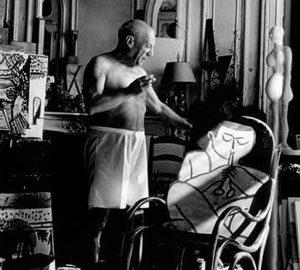
Here at ArtCorner.com, we have a love of all things art. But what happens when you love it too much? Theft is usually the answer. Throughout the ages, thieves have stolen artworks for either love of it or money. art theft 5 Picasso Art Heists and What Became of ThemHowever, finding that no one wants to buy stolen artwork, they often hang on to it themselves, and it can end up in the strangest places. To prove it, we have collected five art heists that involved Pablo Picasso art and what became of them:

  1. Original sketches – Although only valued at $200,000 at the time, these were the first Picasso artworks to ever be stolen. It happened in the University of Michigan during a traveling art exhibit in 1967. They would eventually be found two years later at an auction house and no arrests were ever made.
  2. Collected works – It would take too long to list all the works of Picasso’s that were stolen in 1976 at the Palais des Papes in Avignon, France. The short of it is that 118 paintings, drawings, and other works by Picasso were the target of the thieves. Detectives actually used a fake American crime boss who wanted to buy stolen Picassos as a way to ultimately catch the thieves who took them.
  3. Horse’s Head, Glass and Pitcher – In a two for one heist, these paintings were stolen in February of 2008 in the Pfaffikon gallery near Zurich. It was speculated that two thieves stayed after hours when the gallery had closed, then made off with only two paintings out of thousands. The combined total of these two paintings was valued at about $4.5 million. They were found three years later in Serbia, of all places…
  4. Portrait of Suzanne Bloch – This was part of the art heist that happened at the Sao Paulo Museum of Art in 2007. This Picasso painting and one done by Cândido Portinari’ were the targets of the thieves. The heist took only three minutes to pull off, the loot was worth $55 million, but they were both recovered in 2008.
  5. Head of a Woman – Think art heists happens only in other countries or in the past? That wasn’t the case with this 1965 Picasso sketch. A man literally walked into the San Francisco museum where it was hanging in 2011, snatched the work off the wall during the day, and drove off in a waiting taxi. He would later be identified as wine steward Mark Lugo, arrested the same year, and served 138 days in prison. Other stolen works were also found in his possession and he is facing an additional 15 years.

There seems to be an unexplained romantic flair to art heists, you kind of root for the villain as you imagine a daring “Thomas Crown” type making his way through thick security and grabbing a Picasso off the wall. However, reality is somewhat different. The heist tends to be violent and the thieves are far from the romantic facade we envision. The most frustrating thing about it, is that even if the thieves succeed to vanish with the loot it is very difficult to actually sell the stolen pieces, and the art ends up hidden at an undisclosed location, many times, never to be found.

Things you may not know about Picasso

From Ruiz to Picasso: Pablo Picasso had 14 names but ultimately chose to adopt his Mother's surname as his artist name and signature.

Written by Cristiana Dumitru on December 29, 2011

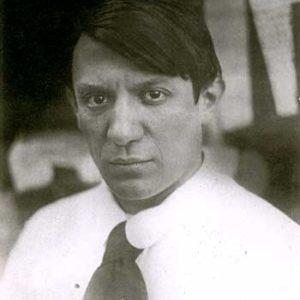
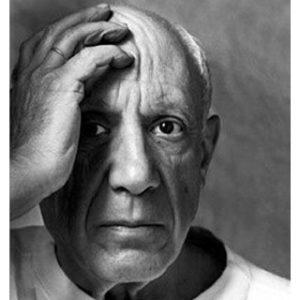
picasso young 224x300 Things you may not know about PicassoThe name Picasso was brought to life between 1897 and 1899. This is the period when Pablo Ruiz decided to change his name. The young painter ceased to sign his paintings with the name of his father and chose to finally adopt his mother’s name. Thus, he opted not to use any of his fourteen names: Pablo Diego José Francisco de Paula Juan Nepomuceno María de los Remedios Cipriano de la Santísima Trinidad Martyr Patricio Clito Ruíz.

The decision to use the Picasso name was thought over a long period of time. He experimented with variations of his maternal family name, by signing his drawings with “Picaz”, “Picasa”, sometimes accompanied by the undeniable nickname “Io”. The painter claimed that his father’s name was too common in Spain, and the desire of changing it came through the impulse that the exotic sounds of his mother’s name gave to him, marked by doubling the letter S. “Even the names Matisse, Poussin and Rousseau have the letter S doubled “, Picasso confessed to his photographer Brassai.

There are other speculations, as to what motivated Picasso to adopt his mother’s surname: It was said that Pablo changed his father name out of superstition. His father, also a painter, had not been successful and had a mediocre career. Thus, the young painter wanted to drive away this bad luck, once he became aware of his unmatched talent.

Whatever the reason for his choice, the name Picasso eventually became one of the most dominant in the art world, and in particular, is attributed to Cubism. The name’s destiny was to become the most important brand for twentieth-century art.

Becoming Picasso

From Catalonian techniques to Cubism style

Written by Cristiana Dumitru on October 24, 2011

picasso Becoming PicassoWhen we think about Pablo Picasso, we think he was genius. But he was a child once. He was a student, too. He had his fears and doubts. What was the road that made Picasso become the contemporary art genius symbol?

His life is seemingly divided by a series of important events which lead him to become the greatest painter of the 20th Century. Picasso dedicated his body and soul to painting. His father, who was also a painter, teaches him Catalonian painting techniques which are his first steps to becoming an artist.

By the end of the First World War, Pablo does not seek any artistic recognition, he doesn’t take part in any exhibition. The amazing precocity of the young artist is developed under the careful guidance of his father. His first true painting is believed to be “Picador,” made in 1890. His brilliancy is tied to the story that tells how Pablo promoted all the entrance exams at the Fine Arts School in Barcelona in just one day.

In his first studies, young Pablo is directed by his father to the sacred art. This is when at Jose Garnelo Alda’s workshop, Picasso made the “First Communion,” in the winter of 1896. The painting was accepted at the Municipal exhibition in Barcelona, and is the first officially recognized academic work. The painting has enjoyed such success, that he receives an order from a monastery in Barcelona. Picasso claimed that these were his first sold paintings.

Later, Picasso becomes exposed to the Prado Museum painters, specifically El Greco. El Greco supposedly influenced Picasso when he was going through the so-called “blue period.” The success of the religious art makes him try and paint a larger picture, “Science and Charity.” Legend has it that the canvas was so big that it had to be inserted into the workshop, through the window. However, an X-ray examination revealed that this painting was made over another drawing, a scene of a battle. The recycled canvas was a common habit in his youth, for economic reasons. The custom was kept up until his first Parisian success. Even though these paintings haven’t got the same values as the cubist ones, they are considered to be studies that have led him to follow the path of Cubism.

In the coming years, Picasso learns techniques that distance him from the academic style. In Barcelona, around 1907, he is part of a group of artists who frequent the cabarets and have a culture that oscillates between English Pre-Rafaelism and an attitude of bohemian life. Therefore, Picasso dedicates his paintings to numerous cabarets. In 1909, Pablo has his first solo exhibition with a few charcoal drawings, portraits of his friends made in expressionist style. It is also the time when he decides to change his pattern name, Ruiz to Picasso, his mother’s surname.

In that autumn, Pablo meets the avant-garde Paris. On this occasion, he made one of the first paintings that ultimately defined his own personality, “Mill of Galette.” This was also his first sold canvas in France. Picasso began increasingly more to break from the Catalan style and is inspired by the representative painters of Post-Impressionism. He is drawn, in particular, to Toulouse Lautrec’s paintings.

The most common theme among the Catalans was the night life. Therefore, this could not be left out from Picasso’s paintings during his stay in Paris.

BLUE NUDE 250x300 Becoming PicassoIn the coming years, he spent time traveling between Spain and France. These years were marked by poverty, but rich in artistic experience. It is the period in which blue predominates in his paintings. The artist becomes concerned with the symbolic approach rather than painting the reality as true as possible. The Blue Period begins with works inspired by the death of his friend, Casagemas. The paintings capture characters encountered in his travels around the year 1902. Representative for this period is the “Blue Nude.”

Picasso permanently moved to Paris in 1904, when he attempts the Catalan’s colony meetings, and makes numerous visits to the Medrano Circus. This is when the harlequins came in his center of attention and become a predominant theme in his paintings. At the same time, he gets rid of the Symbolism style and takes as a reference point the French artist’s style such as Vincent Van Gogh and Paul Gauguin. From Paul, he acquires a primitive approach. From the almost monochrome palette he used in the blue period, his paintings are now rich in color and his characters are from the circus world. In 1905 two of these works are on display for a while at the Venice Biennale.

The paintings were withdrawn by the exhibition officer after just a few days because they were considered to be scandalous for those times. This is why for many years, Picasso didn’t want to participate in any official exhibition. Instead, he starts to be passionate about the “art negre” style from which he gets inspired to make cubist paintings. This was the beginning of a new era for him as well as for the world he inspired.

The authentic painters can never lie on laurels. They know only to lead an eternal and miserable existence, that of painters.” – Pablo Picasso

Sleepless in Picasso

A Sepcial Picasso exhibit now on display at the Seattle Art Museum

Written by Amitai Sasson on January 1, 2011

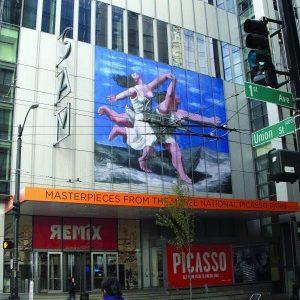
picasso in seattle Sleepless in Picasso Pablo Picasso the great, the Michelangelo of the 20th century, the raging bull of modern art is exhibiting in Seattle.

The Seattle Art Museum, is host to a comprehensive exhibit of the modern master, artist Pablo Picasso. These are Picasso’s private stash of art pieces that he did not intend to reveal or sell. In today’s art market, the value of this artwork is nearly incalculable. And you need to take yourself, family or friends to see this show, because, unless you travel to Paris any time soon, you won’t get another chance.

Picasso’s enormous collection was “given,” in lieu of inheritance taxes, to the French government, who quickly outfitted a large, handsome but derelict hotel in Paris with the enormous collection. Right now, the museum is closed for two years of renovation. Vive l’opportunite!

With all the intrigue of a modern espionage novel, the curators of the Seattle Art Museum where able to somehow finagle Paris into loaning its collection to Seattle through Jan. 17.

Picasso burst on the Paris scene like a burst of talent, the art world had not seen before. To say that Picasso was a precocious talent at age 19 is an understatement. He could already paint and draw like a master.

And paint he did. The collection is an undeniable display of all the glamor, brilliance and command of the many media that Picasso thrust upon an evolving 20th century art world, a world already reeling from the impact of Impressionism and Post Impressionism and the first extraordinary artworks by modern painters from Claude Monet to Vincent Van Gogh.

Picasso fathered the next giant steps that led to the modern-day transformation from painting as representation, to, well … be my guest in defining this potpourri of expression.

Most of his paintings stun a vibrant imagination. Two Women Running on the Beach, The Village Dance, Cat Catching a Bird, sketches from Guernica, playful and provocative sculpture – all this work is displayed with deep passion, eroticism, and of course, all the creativity of an artist who might be defined as the raging bull of modern art.

At the beginning of the exhibit, one is confronted by a life-size photograph, a self-portrait of the artist as a young man, around age 24, standing resolutely with two deep-set black eyes blazing, almost challenging, muscles hard and taut, and with a pose that suggests an ego beyond Picasso’s cool and calculating confidence, of which he is generally accused of exhibiting by the boatload. He seems to suggest in a prescient sort way that, yes, he is going to become an artist of unsurpassed depth and imagination. His black and white drawings suggest a master on terms with Rembrandt or Picasso’s fellow Spaniard, Goya. Certainly, Picasso does not surpass either. But to be held on a par with such genius and talent speaks volumes, and Picasso did speak volumes. This quotation is a favorite: “God is really only another artist. He invented the giraffe, the elephant and the cat. He has no real style. He just goes on creating other things.”

His bigger than life nature, like his artwork, must have remained irresistible, just as this show is irresistible. In the sketches and studies of Guernica (the original remains in Madrid), rage and indignity confront us with all the power of a full-force Blitzkrieg.

In a strange way, it doesn’t matter if you like abstract painting or not. Picasso is the giant of expressionism and the creator of many emerging art styles. He was always ahead of the pack, bursting from the starting gate like Secretariat or Sea Biscuit. It can hardly be denied. You may dismiss his style, but must not reject the talent.

Picasso Breaks the Auction House Record

Written by Amitai Sasson on May 6, 2010

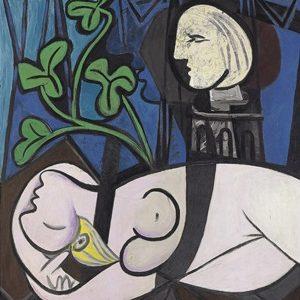
picassonudegreenleavesandbust 240x300 Picasso Breaks the Auction House RecordOn Tuesday night, Pablo Picasso was restored to what many consider his rightful place at the top of the most important artists in the world. A canvas that he painted in a single day in March 1932 was bought for $106.5 million (£70.3 million) at Christie’s in New York – making it the most expensive work of art ever sold at auction. The news must have turned dealers, auctioneers and art collectors delirious with delight as in the art world, at least, the good times appear to be back.

This is not the first time that Picasso has held this exalted record. In 2004, his Boy with a Pipe, which dates from 1905 at the height of his so-called Rose Period, sold at Sotheby’s in New York for a record-breaking $104.1 million. The extraordinary thing is that Picasso’s Nude, Green Leaves and Bust, which set the new record this week, looks nothing like Boy with a Pipe, in subject matter or style. Most people unfamiliar with modern art would surely assume that the two paintings had been made by different artists.

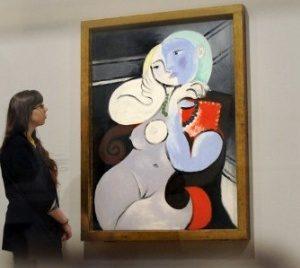
Nude, Green Leaves and Bust, which was last sold, for $19,800, to a family of American art collectors in 1951, is a very different proposition. It shows a naked woman lying asleep beneath a classical bust and a rampant philodendron plant – but it is not remotely realistic. The bold blocks of colors are flat and intense, bound by thick black outlines. The woman’s skin is an extraterrestrial lavender. Her arms are not anatomically correct, but instead curl beneath her head, mirroring the tendrils of the plant above her. A shadowy profile (a self-portrait?) floats among the folds of the blue cloth in the background, in between the plant and the bust. Overall, the painting has a distorted, dreamy, childlike aspect. Nearly three decades after Boy with a Pipe, Picasso was no longer interested in making paintings that even pretended to be life-like.

The story behind Nude, Green Leaves and Bust helps us to understand why it is considered such a wonderful work of art – and why Picasso, in the words of one of his dealers, illuminated the 20th century like a comet.

The woman is a portrait of Picasso’s muse and mistress Marie-Thérèse Walter, whom the artist met in the 1920s, when he was in his mid-40′s, and she was still a teenager. “When I met Picasso I was 17,” Marie-Thérèse said in an interview with Life magazine in 1968. “I was an innocent young gamine. I knew nothing – life, Picasso, nothing. I had gone shopping at the Galleries Lafayette, and Picasso saw me coming out of the metro. He simply grabbed me by the arm and said: ‘I’m Picasso! You and I are going to do great things together.’”

Picasso and Marie-Thérèse soon began an affair, which rejuvenated the middle-aged artist and quickly suffused his work. He embarked on a run of sumptuously erotic canvases which are the visual equivalent of great love poems. These dazzling paintings, of which Nude, Green Leaves and Bust is a fine example, are characterized by bright, joyful colors and plump, suggestive forms. Their brushwork is lush and fluid. Marie-Thérèse is frequently presented naked and asleep, as though resting after sex.

For better or worse, Picasso took a wrecking ball to six centuries of art history – and, by grappling with the great Western tradition, he fashioned a revolutionary new visual language better known as the modern art era.

Top 10 Oil Paintings of Motherhood

Written by Amitai Sasson on April 20, 2010

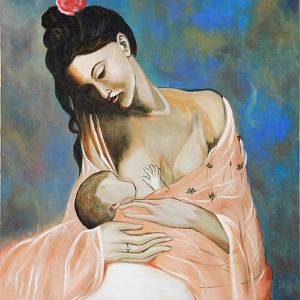
MATERNITY 250x300 Top 10 Oil Paintings of MotherhoodoverstockArt.com, the leader in handmade oil painting art reproductions, released today its Mother’s Day Top 10 list. This year’s list names the top 10 oil paintings featuring images of motherhood.

Topping the chart is Claude Monet’s masterpiece Poppy Field in Argenteuil. Oil paintings by master artists Mary Cassatt, Gustav Klimt, Vincent van Gogh, Pablo Picasso, and Pierre-Auguste Renoir also made the list.

“Many master artists depicted images of motherhood in their oil paintings,” said Stacy Sasson, co-founder of overstockArt.com. “No other art form better exemplifies the tender, timeless bond between a mother and a child.”

The oil paintings that made the 2010 Mother’s Day Top 10 list are:

  1. Poppy Field in Argenteuil, Claude Monet – In this colorful oil painting, originally created in 1873, Claude Monet painted his wife and son strolling together among the poppies.
  2. Le tre eta della donna (Mother and Child), Gustav Klimt – Mother and Child is part of Klimt’s famous oil painting Three Ages of Woman. The painting depicts an image of a mother cradling her young son. The original was created in 1905, three years after the death of Klimt’s baby son, Otto.
  3. Breakfast in Bed 1897, Mary Cassatt – The subject of mothers and children recurred in many of Cassatt’s works. In this piece, a child’s attention wanders as she is held in her mother’s loving embrace.
  4. First Steps, Vincent van Gogh – From late 1889 to 1890, while van Gogh was a voluntary patient at the asylum in Saint-Rémy, he painted twenty-one copies of Jean-François Millet’s works. In January 1890, van Gogh transferred a photograph of Millet’s First Steps to canvas.
  5. Maternity, Pablo Picasso – This stunning oil painting, originally created in 1905, depicts the intimate bond of mother and child.
  6. Madame Monet and her Son, Claude Monet – This masterpiece, originally painted in 1875, depicts Monet’s first wife Claude and their eldest son, Jean.
  7. Summertime, Mary Cassatt – Although never a mother herself, Cassatt principally painted children and scenes of motherhood. Summertime illustrates a mother and daughter enjoying a leisurely summer day boating. The original masterpiece was created in 1894.
  8. Woman with a Parasol and Small Child on a Sunlit Hillside, Pierre-Auguste Renoir – Originally painted in 1874, this masterpiece depicts a mother relaxing in the grass while her young child wanders off in behind her in the tall grass.
  9. Hope II, Gustav Klimt – Although images of women and children are frequent in the history of art, depictions of pregnancy are rare. In Hope II a woman lowers her head toward her swelling belly. The original masterpiece was created in 1907-08.
  10. Pieta, Vincent van Gogh – Originally created in 1889 while van Gogh was staying at the asylum in Saint-Rémy, Pieta is the agonizing depiction of Mary in sorrow over her dead son.

The Mother’s Day Top 10 List was composed by pulling overstockArt.com sales data from April 2009 to March 2010. “Mother’s Day is our third busiest selling period of the year,” said Sasson. “People love giving their moms the gift of art for Mother’s Day – it is a wonderful expression of love that will last a lifetime.”

brought to you by overstockArt.com

Get Updates by Email

Browse Recent Stories

  • Joseph William Turner - Tintern Abbey
  • Da Vinci - Lady With an Ermine
  • Cezanne - Bricoo, Bicchiere e Piato
  • join the artistic conversation on facebook!
  • Dali - Swans Reflecting Elephants
  • Picasso stolen from Greek gallery
  • Vincent Van Gogh - Sunflowers (Artist Interpretation Red)
  • The most Romantic Art - Gustav Klimt the Kiss Oil Painting
  • Van Gogh - Vase with Fifteen Sunflowers
  • Van Gogh - Vase with Fifteen Sunflowers
Claude Monet Oil PaintingsVincent Van Gogh PaintingsGustav Klimt Oil PaintingsPablo Picasso Oil Paintings