Things you may not know about Picasso

From Ruiz to Picasso: Pablo Picasso had 14 names but ultimately chose to adopt his Mother's surname as his artist name and signature.

Written by Cristiana Dumitru on December 29, 2011

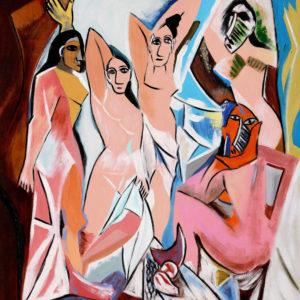
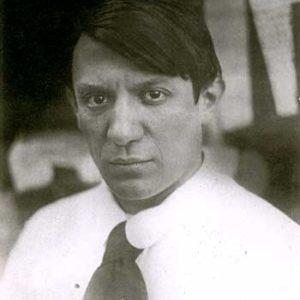
picasso young 224x300 Things you may not know about PicassoThe name Picasso was brought to life between 1897 and 1899. This is the period when Pablo Ruiz decided to change his name. The young painter ceased to sign his paintings with the name of his father and chose to finally adopt his mother’s name. Thus, he opted not to use any of his fourteen names: Pablo Diego José Francisco de Paula Juan Nepomuceno María de los Remedios Cipriano de la Santísima Trinidad Martyr Patricio Clito Ruíz.

The decision to use the Picasso name was thought over a long period of time. He experimented with variations of his maternal family name, by signing his drawings with “Picaz”, “Picasa”, sometimes accompanied by the undeniable nickname “Io”. The painter claimed that his father’s name was too common in Spain, and the desire of changing it came through the impulse that the exotic sounds of his mother’s name gave to him, marked by doubling the letter S. “Even the names Matisse, Poussin and Rousseau have the letter S doubled “, Picasso confessed to his photographer Brassai.

There are other speculations, as to what motivated Picasso to adopt his mother’s surname: It was said that Pablo changed his father name out of superstition. His father, also a painter, had not been successful and had a mediocre career. Thus, the young painter wanted to drive away this bad luck, once he became aware of his unmatched talent.

Whatever the reason for his choice, the name Picasso eventually became one of the most dominant in the art world, and in particular, is attributed to Cubism. The name’s destiny was to become the most important brand for twentieth-century art.

My Visit to the SFMOMA: The Art and Influence of the Stein Family

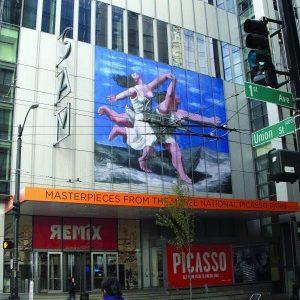
On my journey to explore the top art museums in the world, I came across the San Francisco Museum of Modern Art (SFMOMA) as they premiered their new exhibition: The Steins Collect: Matisse, Picasso, and the Parisian Avant-Garde.

Written by Amitai Sasson on August 26, 2011

mattise My Visit to the SFMOMA: The Art and Influence of the Stein FamilyAs I stepped into the SFMOMA, it was clear that the Steins had an enormous impact on this special landmark of San Franciscan Art. The Stein family, were the center of attention and their influence on the art scene of the entire West Coast did not go unappreciated.

The Steins are responsible in many ways for the turn-of-the century revolution in the visual arts through their adventurous patronage, deep ties to leading minds of the era, and legendary Paris salon gatherings. As powerful `tastemakers`, they had a commitment to the new, a confidence in their inclinations, and a drive to build appreciation for the work they loved. From the moment they first dared to admire Matisse’s scandalous Woman with a Hat (1905)—the “nasty smear of paint” that gave the fauves their name—the family was staking claims for modern art that would heavily influence their peers and transform the careers of several of the most important artists of the 20th century such as Henry Matisse and Pablo Picasso.

The Steins Collect: Matisse, Picasso, and the Parisian Avant-Garde reunites the unparalleled modern art collections of author Gertrude Stein, her brothers Leo and Michael Stein, and Michael’s wife, Sarah Stein. Jointly organized by the San Francisco Museum of Modern Art (SFMOMA), the Metropolitan Museum of Art, New York, and the Réunion des Musées Nationaux-Grand Palais, Paris, this major touring exhibition gathers approximately 200 iconic paintings, sculptures, drawings, prints, and illustrated books not only by Matisse and Picasso, who are each represented by dozens of works, but also by Pierre Bonnard, Paul Cézanne, Juan Gris, Marie Laurencin, Henri Manguin, Francis Picabia, Pierre-Auguste Renoir, and Félix Vallotton, among others. The Steins Collect premiered at SFMOMA May 21 through September 6, 2011, before traveling to Paris and then New York.

rivera1 My Visit to the SFMOMA: The Art and Influence of the Stein Family

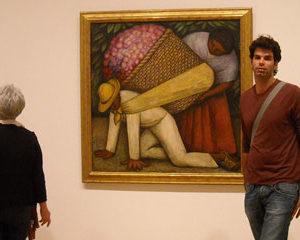
I had a great time touring the SFMOMA, it is a special place in the heart of bustling San Francisco. However, my personal feeling is that although the city of San Francisco owes a debt of gratitude to the Steins, the art in any museum should take center stage. Paying homage to the Steins is good and well, but let us not forget why we are here for… I quickly skimmed through a rich array of archival materials—including photographs, family albums, film clips, correspondence, and ephemera—the exhibition provides on this influential family and went directly to the awesome Modern Art collection the museum has to offer with their powerful Rothko’s, sublime Juan Miro’s and their beautiful Diego Rivera’s. The museum also has an interesting educational annex created in tandem with Google called “Doodle 4 Google” where you can see kids getting involved in the arts. Seeing kids getting immersed in art as they create art in the middle of the SFMOMA was the highlight of my visit. Talk about getting creative!

In conclusion, the SFMOMA is a great visit, but if you have to choose only one modern art museum in San Francisco, then I would suggest peeking into the de Yung at the Golden Gate Park with their Picasso exhibition.

Things you may not know about Monet, Van Gogh, Dali and Picasso

A few facts about some of the world’s most famous painters: Monet’s first passion was caricatures, Van Gogh wanted to become a priest, Dali wrote a book in his honor, and Picasso could have become a poet.

Written by Cristiana Dumitru on August 1, 2011

An artist creates his painting, through his work, people can take a glimpse into the painter’s soul. But what about his life? What are the artists unusual habits? Are there any skeletons in his closet?

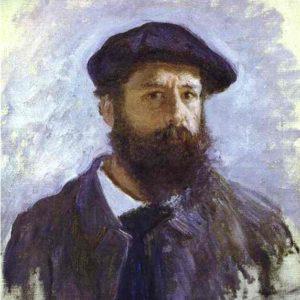
monet 150x150 Things you may not know about Monet, Van Gogh, Dali and PicassoIt is said that the great geniuses of the world were not good at school. Claude Monet is an artist who did not like to study at all. In the short biography published in 1900, the artist said: “School always seemed to me as a prison and I could never convince myself that it was better to stay there, more so as it was four hours a day, when the sea was calm, and I had such a craving mood to stay in open-air.” Few people know that from this boredom appeared Monet’s first passion. During classes, he used to draw on the border of the book’s portraits of his teachers and other personalities in the city. Thus, at 15 years old he was known throughout Le Havre as a cartoonist. His fame earned him quite a few orders from friends and colleagues. He said: „In one month, my sponsors have doubled. I could ask for twenty francs without decreasing the number of orders. If I would have continued drawing caricatures today I would have been a billionaire.”

vangogh 150x150 Things you may not know about Monet, Van Gogh, Dali and PicassoPainting was not Vincent Van Gogh’s first love. The artist had in his youth a special inclination towards religion. He studied theology at the University of Amsterdam, but not for long. Because he did not understand the utility of learning Latin and ancient Greek, he dropped out of school. He later tried to follow a course of a preacher in Brussels, but failed to promote the final exam. After several attempts, the preacher stage ends, and Van Gogh is preparing to pursue his final vocation, that of an artist.

dali 150x150 Things you may not know about Monet, Van Gogh, Dali and PicassoNevertheless, one of the most eccentric artists is Salvador Dali. Convinced that he is a genius, he decides to write his memoirs in the book called „Dairy of a Genius, Salvador Dali.” Dali even makes the difference between him an ordinary person: „From the French Revolution has developed the vicious tendency to believe that geniuses are human beings more or less similar to the rest of the world. Not so true. And if this is false for me, who I am a spiritual genius, it is false for the Renaissance geniuses, like Raphael, who is an almost divine genius. This book will show you that the daily life of a genius, his sleep, digestion, ecstasy, his fingernails, coldness, blood, life and death are different from ordinary people.”

picasso 150x150 Things you may not know about Monet, Van Gogh, Dali and PicassoPablo Picasso is another artist who besides painting had the passion for writing. In fact, when he had been lacking inspiration in drawing, he dedicated his time to poetry. The lyrics are written spontaneously, and the association of words and images is left to run free. The texts are written in a surreal manner, often without punctuation. One of the artist’s poems is dedicated to women:

Girl
Nice carpenter joining axes
With Rose’s thorns
don’t shed any tears
if you see wood bleeding. – Pablo Picasso

Picasso’s Electrician Charged with Theft

French investigation into Pierre Le Guennec's collection leads to indiction

Written by Tiffany Chaney on June 20, 2011

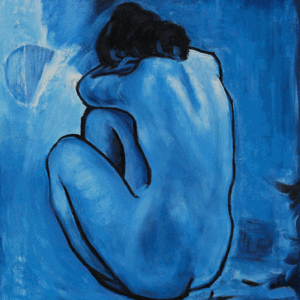
blue nude 250x300 Picassos Electrician Charged with TheftThe body of Picasso’s works were stashed in a garage for forty years until a letter was written to Picasso’s son, asking about the worth of the collection. This letter was written last November by Picasso’s ex-electrician, Pierre Le Guennec, who claimed the collection had been gifted to him by Picasso and his second wife Jacqueline. It was only recently that Le Guennec was formally indicted with possession of stolen property. Le Guennec will appear before a judge later this month on charges.

According to Var Martin, the Le Guennecs were also gifted with 540,000 francs in 1983. The information was revealed by the Picasso Administration in a formal document. This gift occurs ten years after Le Guennec’s employment as an electrician (1970-1973) with the Picasso family. Inside the collection are never seen before drawings, Cubist works, and a rare painting from the Blue period.

However, Le Guennec is not the only one undergoing investigation. Picasso’s ex-driver, Maurice Bresnu, who himself possessed over a hundred of his employer’s works. Bresnu is Le Guennec’s cousin. Police did retain works from an auction of Bresnu’s own collection this June, but investigation has not lead to any evidence of connection between the cases, except for the obvious and unusual factor of familial relation and stolen goods.

Nude, Green Leaves and Bust a Rare Treat for UK

Revered Picasso painting to debut for first time at the British Tate Modern

Written by Tiffany Chaney on April 11, 2011

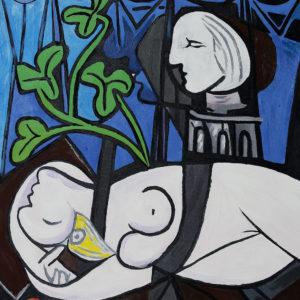
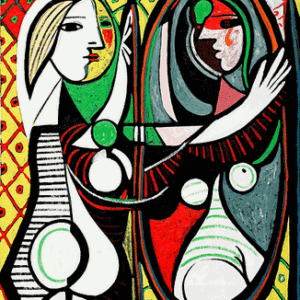
picasso 250x300 Nude, Green Leaves and Bust a Rare Treat for UKLast March the revered Nude, Green Leaves and Bustwas viewed by the British public for the first time available at the Tate Modern in the new Pablo Picasso room.  In May the painting had sold for a record $106.5 million (£65.5 million) at Christie’s in New York. The work features Marie-Therese Walter, the model and lover of the artist, whom Picasso first met in 1927. It is only one of a series of his muse, but the most favored.

Painted on March 8, 1932, Nude, Green Leaves and Bust is the most intensely hued and energetic of the nude pieces Picasso rendered at what is considered by some scholars as the highest point of his creative output. The piece is currently showing next to other Picasso works in the museum’s collection.

Before its auction and public debut, the piece had been with LA based collectors Sidney and Frances Brody for nearly six decades. According to a Tate press release, “They had acquired the work in 1951 from Paul Rosenberg & Co., Paris and New York whom in turn had acquired it from the artist in 1936. During that period it had been exhibited publicly only once, in 1961, to commemorate Picasso’s 80th birthday. The lender wishes to remain anonymous.”

Thanks to this lender’s generosity the British public is in for a rare treat.  An art exhibition exploring links between the artist and Britain will open at the museum in the following year.

Picasso’s Horses

Pablo Picasso's horses, expression of the Spanish Civil War

Written by Amitai Sasson on April 5, 2011

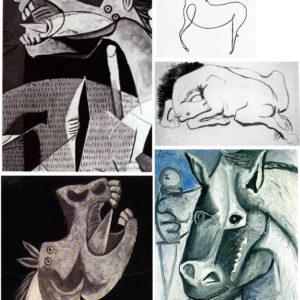
Here are a few of many of Picasso’s horse drawings & paintings. There are many great Pablo Picasso horse drawings from 1936 & 1937 when he was doing studies for Guernica.
PicassosHorses Picassos Horses
The bottom right piece Tete de Cheva was actually stolen from a Swiss museum in 2008. Picasso seems to be very popular with art stealing criminal crowd.

On my trip to visit the Reina Sofia Museum in Madrid, I found the many images of Picasso’s horses to be electrifying! His preparation as he set forth to depict the Spanish Civil War of 1936 in this monumental piece is astounding and awe inspiring.

brought to you by overstockArt.com

Get Updates by Email

Browse Recent Stories

  • Joseph William Turner - Tintern Abbey
  • Da Vinci - Lady With an Ermine
  • Cezanne - Bricoo, Bicchiere e Piato
  • join the artistic conversation on facebook!
  • Dali - Swans Reflecting Elephants
  • Picasso stolen from Greek gallery
  • Vincent Van Gogh - Sunflowers (Artist Interpretation Red)
  • The most Romantic Art - Gustav Klimt the Kiss Oil Painting
  • Van Gogh - Vase with Fifteen Sunflowers
  • Van Gogh - Vase with Fifteen Sunflowers
Claude Monet Oil PaintingsVincent Van Gogh PaintingsGustav Klimt Oil PaintingsPablo Picasso Oil Paintings