The Sunflower Effect: Art Coming to Life (Part III)

The third part of a short story series influenced by Vincent Van Gogh's famous Sunflowers paintings.

Written by Katherine Blakeney on January 29, 2012

sunflowers red 250x300 The Sunflower Effect: Art Coming to Life (Part III)Eleanor’s bedroom here was smaller than the one at home. She lay in a small but comfortable bed by the window, the drawn curtains leaving the room in semi-darkness. Eleanor’s eyes were open, but she was staring blankly at the window, as if unaware of anything around her. Her mother sat by the bed with a look of concern on her face, heedless of the soft rustling sound disturbing the heavy silence. After a while she raised herself from the chair and headed quietly towards the door. Springing up with a sudden burst of energy, Eleanor stretched her arms desperately towards her mother.

“Don’t leave me!” she wailed, “They will come after me! I can hear them climbing up the wall!”

Mother sighed patiently, “Nothing is coming after you dear. You just need some peace and quiet, and everything will be okay.” Of course Eleanor knew it wouldn’t be, but how could she explain? She watched her mother leave in despairing silence.

The rustling and scraping sounds outside the window intensify. Eleanor’s breathing grows heavier. For a moment, the sounds outside cease, and all that Eleanor can hear is the sound of her own heartbeat. Then the curtain concealing the window begins to move as if pushed by some unseen force, and spread over Eleanor’s bed. The scraping sound returns, louder than ever. Eleanor sits motionless, staring at the curtain, unable to utter a sound…

It was a beautiful morning. As Eleanor’s mother came down the hallway with a wholesome breakfast tray, her step was springy and optimistic, and she hummed a cheerful song. Reaching Eleanor’s door, she had to fumble with the tray for a few seconds before she managed to turn the handle. The door swung open to reveal a view of the room.

She was still humming as looked over at Eleanor’s bed. Sitting in the next room, Father heard the humming stop abruptly, and the tray come crashing down to the floor.

katie and sunflowers 2 300x258 The Sunflower Effect: Art Coming to Life (Part III)Eleanor lay sprawled on the bed, her blanket in a tumbled heap on the floor. Her hands convulsively grasped the stem of an enormous sunflower lying on top of her. Her face was entirely hidden from view by its poisonously yellow petals, wrapped tightly around her head. She was dead.

As the cold gray twilight faded over the cemetery, Eleanor’s parents watched as their daughter’s coffin was slowly lowered into the grave accompanied by Mother’s sobs. At least she had the comfort of knowing that everything was just as little Eleanor would have wanted. The grave overflowed with her favorite flowers – sunflowers. Mother tenderly caressed the sunflower found in Eleanor’s room and gazed at it with tears in her eyes.

“Watch over and protect our poor Eleanor. She was so very fond of sunflowers,” she whispered, kissing the flower and lowering it reverently into her daughter’s grave. Perhaps the tears blurred her vision as she turned away, but she didn’t see the Sunflower slowly begin to claw at the lid of the coffin with its predatory leaves. She never did.

Go back to review parts II and I.

Van Gogh and Gauguin: Friendship or Rivalry?

Van Gogh's Relationship with Gauguin was one of the great instigators of their mutual creation.

Written by Cristiana Dumitru on November 10, 2011

gauguin vangogh Van Gogh and Gauguin: Friendship or Rivalry?“A friend should be one in whose understanding and virtue we can equally confide, and whose opinion we can value at once for its justness and its sincerity,” wrote Robert Hall. Could a friend be also your rival? The kind of person who you admire and at the same time you try to overcome? Gauguin and Van Gogh’s friendship meant not only love and support to each other, but also a confrontation in the creation field.

The relationship between Vincent Van Gogh and Paul Gauguin began in Paris, around 1886. The two, along with Bernard, Toulouse Lautrec and Anquentin formed “The Little Avenue group,” as Van Gogh named it, in order to emphasize the contrast with the painters from “The Grand Boulevard,” a name used to designate the famous Impressionists of the time.

Since Parisian life was characterized by competition and stress, and especially because he didn’t sell any painting, Vincent decided to move to Arles, where his friendship with Gauguin grew, evolved and ended. Over time, Van Gogh hoped to host in his home called “Yellow House” several generations of artists, for which he repeatedly calls Gauguin’s presence. Although the difference in age between the two artists was of only five years, Vincent looked at Gauguin as his mentor and hoped that in the time they would spend together he would learn from him many art techniques.

Each critical idea Van Gogh received was taken as an advice on how he could improve his technique. Gauguin considered himself as a true mentor for the young artist to the point where he tried to falsify the date of a painting by Van Gogh, in order to look as if Vincent made it after his arrival in Arles. Vincent didn’t seem to be upset by this gesture.

In the five months until the arrival of Gauguin in Arles, Van Gogh made over 200 paintings, among which the most famous is the series of fruit trees in bloom and the sunflowers. Meanwhile, the two artists were in touch quite often. In addition to invitations to come to Arles, Van Gogh, asked Gauguin’s opinion about the paintings he made. Paul shows his appreciation every time:

I’ve been keeping a close eye on your work, since we parted company. I offer you my sincere compliments, and from many artists yours is the most remarkable work in the Independent’s Exhibition. With things taken from nature, you’re the only one there who thinks…I’ve spoken at length about it to Aurier, Bernard and many others. They all offer you their compliments.”

Van Gogh has also words of praise:

Everything which he does has something soft, calming, amazing about it. People do not understand him yet, and he is suffering because he has not sold anything – just like other true poets.”

In order to convince Gauguin to come to Arles, Vincent calls to his brother, Theo van Gogh. He asks him to give Paul a monthly allowance. After many persistent letters, Gauguin finally accepts and moves in with Vincent. Van Gogh lets Gauguin take the lead-role in art, placing himself in the role of the student. They worked out a lot of motifs together, compared their results and argued over artistic concepts. The two had a difficult life together. They were constantly confronted with health problems, that worsened periodically, and with financial and social difficulties. They used to paint until exhaustion, in true creative outbursts, and later they would not be able to reach the easel for days.

The differences between the two became striking. Van Gogh was impulsive and tied to the fantasy world, while Gauguin was a rationalist and a good tactician. For a while, Van Gogh embraced Gauguin’s theories: he outlined all areas and did not work anymore according to nature. Instead, he painted from his head and adopted the abstract technique. However, Gauguin’s ideas were not so close to his. Therefore, he deviated.

Although initially, it seemed a good plan, coexistence of the two was not without conflict, as Gauguin writes in his memoirs: “Between two human beings, he and myself, the one like a volcano and the other boiling too, but inwardly, there was a battle in store, so to speak.” Gauguin was a much more calculated person, trying to stick to a strict minimum in terms of money, so unacceptable to van Gogh. The thing that shocked Gauguin was the mess Van Gogh was living in. According to Paul what made Vincent angry was acknowledging that he was very intelligent, “for my forehead was too low, a sign of stupidity.” Van Gogh said that the discussions with Gauguin often became so tensed that between the two no longer existed any closeness or friendship. While Vincent needed a gentle and caring friend, the workshop colleague treated him harshly and with irony.

Towards the end of their relationship, exasperated, Van Gogh attempted to drive his friend away, by being loud and offended him with every opportunity. The relationship between the two weakened after Van Gogh’s outbreaks. He threw a glass of absinthe on Gauguin while they were in a cafe, then attacked him with a razor while they were in the workshop. Exasperated, Gauguin notified Theo that he had enough and wanted to leave. Later, Van Gogh, in a bout of nerves, cut his ear.

The friendship between the two finally ended, and Gauguin refused to have anything to do with a “crazy person.” While working at the same workshop in Arles, the two easily influenced each other. Subsequently, each quickly returned to their old style: Van Gogh painted outdoors in spontaneity, and Gauguin’s work became extensively studied.

Vincent’s Vision: A Place Where Painters Can Find Freedom

More hidden facts about the life of Vincent Van Gogh reveal that he had a vision to overcome loneliness by creating a special place for artists to collaborate.

Written by Cristiana Dumitru on October 19, 2011

“I always thought it was abnormal for painters to live alone. You waste your time if you stand alone.” These are the words of Vincent van Gogh to his brother Theo, on 1 June 1888. The artist fostered the development of a workshop where painters would exchange ideas and experiences and make masterpieces side by side. The workshop was to be organized so that the rules of society and art schools would not enter. This was the place where artists would come from all over the place, artists who did not want to be under pressure from critics, where artists would be free to paint whatever they felt.

vangogh gauguin Vincent’s Vision: A Place Where Painters Can Find FreedomThe loneliness which confronted van Gogh throughout his lifetime made him think more ardent about the possibility of making such a place on his own or perhaps with the help of a few friends. The dream of a community of artists living and working together is strongly cultivated by Van Gogh during his stay in Arles. To achieve this, he appealed through letters to Theo, Gauguin and Bernard.

The model to which Van Gogh aspired was the medieval brotherhoods. He even writes to Theo about it in August 1888. “Living like monks or hermits, having work as the dominant passion and, giving up the well-being.” Van Gogh hoped that by association with other artists, the painters financial situation will not be dramatic anymore. Many had a big number of debts, while others lived in extreme poverty until the end of their lives.

This could not happen, said Van Gogh, if artists had lived together. Another model that he was inspired by was the Pont-Aven circle, the city where, in 1886, he joined with Gauguin and Bernard, a group of artists with common goals. The last model, Van Gogh was inspired by was the Japanese tradition. The artist would lead this workshop in the South and will entitle Gauguin as its “abate.”

The financial support would come from his brother, Theo, as it turns out from one of the letters Van Gogh send to him: “My idea is to create and manage to leave to posterity a workshop where my successors can live. I do not know if I make myself understood, but, in other words, we make art, we manage business deals, which will be continued by those who come after us. If others say it is too far from Paris, let them say.” This utopia has been maintained for a long time by Gauguin, who supported him for a while.

They would talk about founding together the “Atelier du Midi,” where Bernard, Seurat and Signac would also be involved. Van Gogh’s dream was shattered by the tragic event happened in Arles, when the artist cut his year after an argument with Gauguin. Before this the two started an experiment to see how this communion would work. Van Gogh instead several times for Gauguin to come to Arles to find a studio according to his ideas and be its director. Gauguin postponed his departure again and again, finding excuses in letters and financial loop-holes. In his memoirs, Gauguin explains the fact that he hesitated to honor the invitation because of a “vague instinct” that gave him the presentiment of something abnormal.

Despite this he went to Arles. The two had different personalities. One was like a volcano, and the other was boiling inwards. Thus, the friendship was rocked from the beginning. It all culminated in a tragedy. Gauguin used the whole episode as a long-awaited excuse to justify his finally leaving Arles. The two have never worked together again and thus Van Gogh’s dream of having a workshop collapsed. Van Gogh came to terms with his situation quickly, and he decided not to bother with the idea of a workshop any longer. He wrote to his brother: “I have tried to get used to the idea of starting afresh, but at this present time it is impossible for me.”

In his time spend in Arles, Van Gogh passed through the yellow period. The results were the famous Sunflower paintings.

Things you may not know about Monet, Van Gogh, Dali and Picasso

A few facts about some of the world’s most famous painters: Monet’s first passion was caricatures, Van Gogh wanted to become a priest, Dali wrote a book in his honor, and Picasso could have become a poet.

Written by Cristiana Dumitru on August 1, 2011

An artist creates his painting, through his work, people can take a glimpse into the painter’s soul. But what about his life? What are the artists unusual habits? Are there any skeletons in his closet?

monet 150x150 Things you may not know about Monet, Van Gogh, Dali and PicassoIt is said that the great geniuses of the world were not good at school. Claude Monet is an artist who did not like to study at all. In the short biography published in 1900, the artist said: “School always seemed to me as a prison and I could never convince myself that it was better to stay there, more so as it was four hours a day, when the sea was calm, and I had such a craving mood to stay in open-air.” Few people know that from this boredom appeared Monet’s first passion. During classes, he used to draw on the border of the book’s portraits of his teachers and other personalities in the city. Thus, at 15 years old he was known throughout Le Havre as a cartoonist. His fame earned him quite a few orders from friends and colleagues. He said: „In one month, my sponsors have doubled. I could ask for twenty francs without decreasing the number of orders. If I would have continued drawing caricatures today I would have been a billionaire.”

vangogh 150x150 Things you may not know about Monet, Van Gogh, Dali and PicassoPainting was not Vincent Van Gogh’s first love. The artist had in his youth a special inclination towards religion. He studied theology at the University of Amsterdam, but not for long. Because he did not understand the utility of learning Latin and ancient Greek, he dropped out of school. He later tried to follow a course of a preacher in Brussels, but failed to promote the final exam. After several attempts, the preacher stage ends, and Van Gogh is preparing to pursue his final vocation, that of an artist.

dali 150x150 Things you may not know about Monet, Van Gogh, Dali and PicassoNevertheless, one of the most eccentric artists is Salvador Dali. Convinced that he is a genius, he decides to write his memoirs in the book called „Dairy of a Genius, Salvador Dali.” Dali even makes the difference between him an ordinary person: „From the French Revolution has developed the vicious tendency to believe that geniuses are human beings more or less similar to the rest of the world. Not so true. And if this is false for me, who I am a spiritual genius, it is false for the Renaissance geniuses, like Raphael, who is an almost divine genius. This book will show you that the daily life of a genius, his sleep, digestion, ecstasy, his fingernails, coldness, blood, life and death are different from ordinary people.”

picasso 150x150 Things you may not know about Monet, Van Gogh, Dali and PicassoPablo Picasso is another artist who besides painting had the passion for writing. In fact, when he had been lacking inspiration in drawing, he dedicated his time to poetry. The lyrics are written spontaneously, and the association of words and images is left to run free. The texts are written in a surreal manner, often without punctuation. One of the artist’s poems is dedicated to women:

Girl
Nice carpenter joining axes
With Rose’s thorns
don’t shed any tears
if you see wood bleeding. – Pablo Picasso

It’s Not Van Gogh, It’s His Brother

Experts at the Van Gogh Museum discover a self-portrait isn't what it seems

Written by Tiffany Chaney on July 8, 2011

Last week, the Van Gogh Museum told press officials that a known self-portrait by Van Gogh isn’t really the artist, it’s his brother, Theo. Vincent Van Gogh’s brother was a major patron of his artwork, supporting Vincent throughout most of his life, morally and financially.

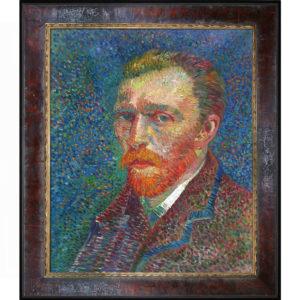
vangogh Its Not Van Gogh, Its His BrotherArt historians at the museum say that if this is true then the “self-portrait” will be the only known portrait created by Van Gogh of his brother, aside from casual sketches. Museum spokeswoman Linda Snoek said that the piece was rendered in 1887, when the brothers resided together in Paris. It seems this era of Vincent Van Gogh’s life isn’t well known, except through a few letters exchanged between the brothers.

The brothers are close in resemblance, but scholars say that it is in fact Theo for a number of reasons. A CBS news source shares the following comparisons, “The portrait of Theo shows he had rounder ears than Vincent did. The other portrait shows Vincent with long, angular ears, consistent with other artists’ paintings of Vincent. That is before he famously self-mutilated one of his ears in December 1888.

In addition, Theo’s goatee is more yellow-brown than Vincent’s dark red beard, and Theo has shaven cheeks, consistent with photographs of him from the same period, while Vincent painted himself sporting mutton-chop sideburns.”

Another Van Gogh Self-Portrait (1887), with “mutton-chops”

vangogh2 Its Not Van Gogh, Its His BrotherVan Gogh rendered this self portrait in 1887. He made the move to Paris to live with Theo in 1886, aged 32 years. This was at the height of the Impressionist movement, where he was inspired by and moved alongside Monet and Gauguin. He and Gauguin worked together in Arles, where Van Gogh painted sunflowers to help decorate Gauguin’s residence. Interestingly, the sunflowers are later found in several of Van Gogh’s artworks. The exposure to Impressionism inspired the use of dramatic color in his modern art pieces.

In 1888, mental illness began to become more evident. It was the year that he suffered from bouts of epilepsy, psychotic attacks, and delusions. In one episode he took a knife to his ear and severed it, and later offered the removed ear to a prostitute. This was the same knife he assaulted Gauguin with earlier in the day. Before the episodes became severe, Van Gogh dreamed of creating his own school with Gauguin and other artists.

Vincent left Saint-Rémy-de-Provence in 1890 and regained contact with Theo. Though he viewed his life and work as a failure, he continued to paint a new work almost daily. Paint flowed through his veins. It was during this time that he created Starry Night, a beloved favorite for most in the world. Whatever fueled his artwork could not be rendered fast enough, like many artists who speak of death at the hands of their muse.

On July 27, 1890 Van Gogh shot himself in the chest and survived the suicide attempt, but he died from the wound two days later. Theo was devastated and inherited the majority of Vincent’s work. Six months later Theo, too, died. His widow took Vincent’s work to Holland to advocate for the work of a brilliant artist and his most supportive patron, his brother Theo.

The mad artist who never stopped painting

Mad Art: Vincent Van Gogh - His Madness Flamed his Artistic Creativity.

Written by Cristiana Dumitru on June 26, 2011

van gohg 300x164 The mad artist who never stopped paintingArt is passion. Art is passion for those who make it and for those who look at it.

When you create you are absorbed, you don’t realize the time passing, you don’t need a human near, you are preoccupide by just creating, you even forget about yourself.

When you view art, you are absorbed into someone else’s creation, you search for a meaning, for your own vision, for an answer, as small as it may be. Art is freedom, the freedom to create, to dream for the impossible and to put it on a paper, to look at it and to search for your own imagination.

Such freedom maybe what Vincent Van Gogh searched for. Is it so that madness is a prison or maybe the freedom of the mind? What is interesting is that the mad painter, Van Gogh, never forgot to follow his passion, painting, even when he had his first breakdown, on the 23rd of December 1888. On that night Van Gogh cut his ear and sent it to a lady companion, named Rachel. Signs of his personality disorder are found in his boderline behavior. On the one hand he had a strong religious fanaticism and on the other hand he had failed love experiences. He was also deeply disappointed in life and felt non-integrated in his own environment.

About all these sufferings he wrote to his brother before the “ear” incident. He said that his deep disappointment is caused by the “despair in which I live due to failure of each action I undertook so far and for which I deserve a thousand reprimands”.

Despite his bouts of madness, Van Gogh never stopped painting. His famous Starry night was completed a year after, in June 1889. That for me is proof that no matter how lost a painter is he will never lose his passion for art, he might loose his mind, but he will never lose his talent.

In the period he painted this masterpiece he was confined to the Saint Remy Asylum. The painting represents an impressive demonstration of the uniqueness of how he perceives and interprets nature. In that period at Saint Remy he lost his faith so in order to find his inner peace he used to paint at night.

Van Gogh might be the artist who best represents the myth of misunderstood genius, a genius that could never paint in such a way if he had been a normal person and not a mad man.

brought to you by overstockArt.com

Get Updates by Email

Browse Recent Stories

  • Joseph William Turner - Tintern Abbey
  • Da Vinci - Lady With an Ermine
  • Cezanne - Bricoo, Bicchiere e Piato
  • join the artistic conversation on facebook!
  • Dali - Swans Reflecting Elephants
  • Picasso stolen from Greek gallery
  • Vincent Van Gogh - Sunflowers (Artist Interpretation Red)
  • The most Romantic Art - Gustav Klimt the Kiss Oil Painting
  • Van Gogh - Vase with Fifteen Sunflowers
  • Van Gogh - Vase with Fifteen Sunflowers
Claude Monet Oil PaintingsVincent Van Gogh PaintingsGustav Klimt Oil PaintingsPablo Picasso Oil Paintings